2025-12-11 Construction Work in Reutlingen

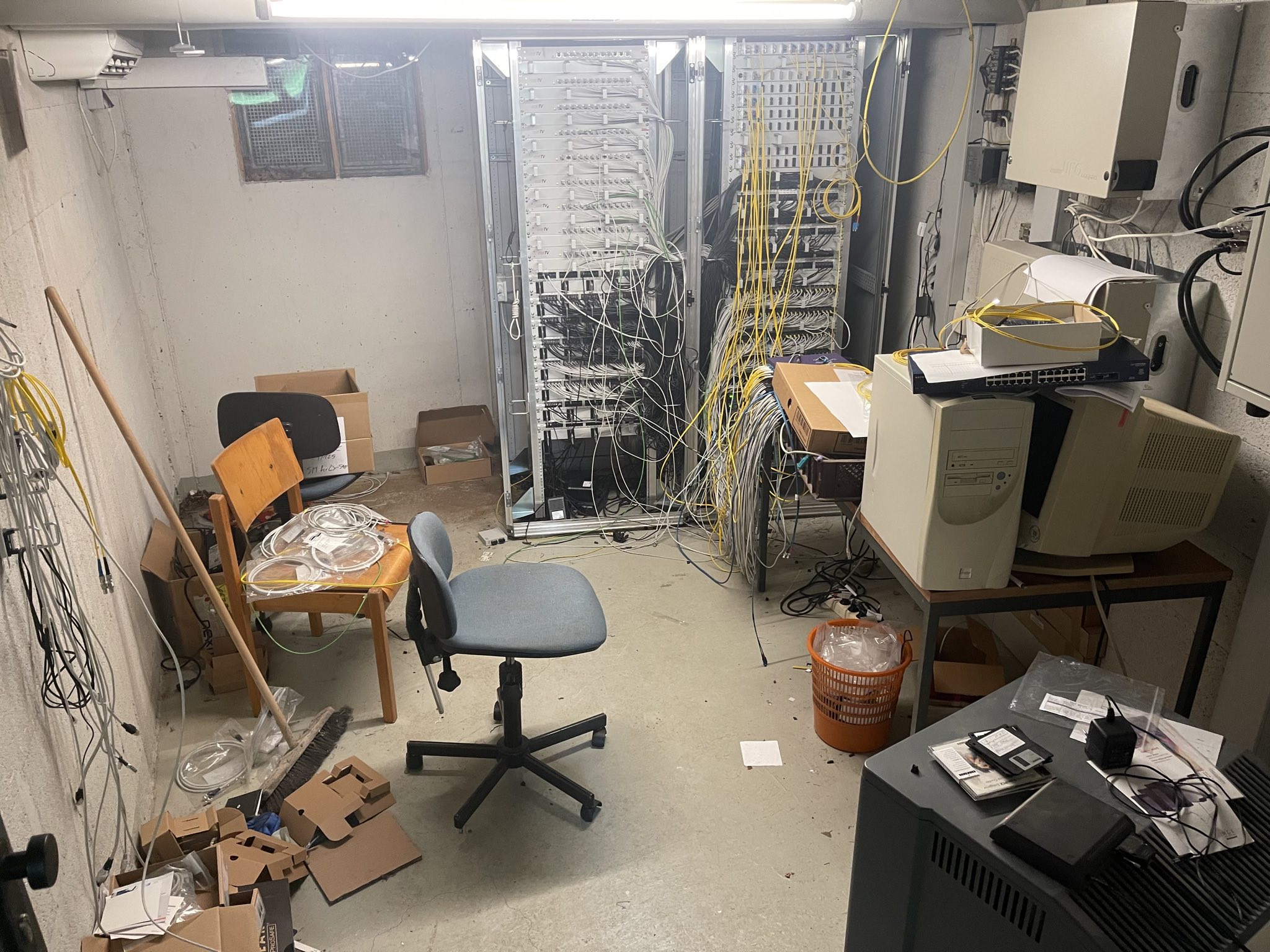
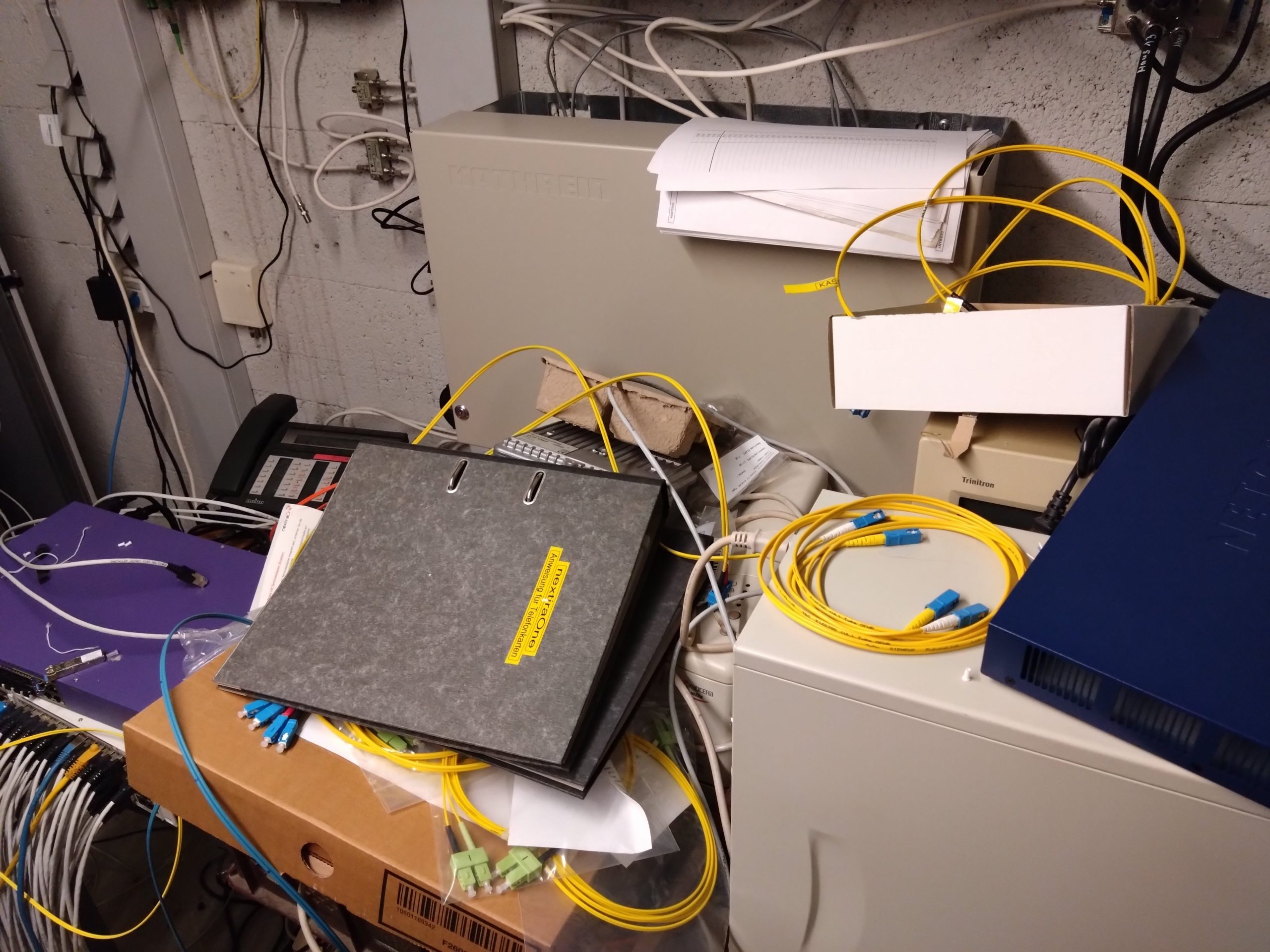
We detected several outages today, including a longer one, at Pestalozzistraße 41 in our monitoring system.

While looking for the cause, we found out that there is intensive construction work going on in the building.

At the moment, all switches except one are online. The following rooms are connected to that switch:
Ground floor 8–12, 1st floor 117–121, 2nd floor 217–221, and 3rd floor 317–321.

We do not know whether these rooms are occupied during the renovation. If they are, please contact us immediately!

We will ask the Studierendenwerk what is going on.

Since all of our dormitories in Reutlingen are connected through this building, we hope that our hardware is not being damaged.

Update: A power line was cut and has now been repaired.

2025-11-30 Maintenance Upgrade Hibuka

At the Hibuka in the French Quarter, we were able to recruit an Erasmus student for our working group for last week.

Many buildings in the quarter currently do not yet have gigabit connections in the rooms. We are using this opportunity to upgrade the local infrastructure.

Wankheimer Täle 1 forms the central uplink of the French Quarter as well as the buildings in Eugenstraße. During the work, there may be temporary internet outages there.

Our team will start on Sunday, 30 November 2025, at around 10 a.m. and will work its way from building to building. Anyone who would like to have a look at our network technology is warmly invited to stop by.
We will update this blog post regularly throughout the day.

Update, Saturday 6 p.m.: We will only start installation work tomorrow at 12 o’clock.

Update Sunday 1 p.m.: we are starting in Wankerheimer Täle 1

Update Sunday 5:20 p.m.: Provenceweg 1 and Landkutschersweg 4+6 are pretty much finished.

There will still be a short outage of the entire buildings when we switch the fiber connection from 1 to 10 gigabit.

Update Sunday 7 p.m.: The switch to 10 gigabit could not take place due to excessive attenuation on the fiber. The outage lasted 1.5 hours, longer than expected, because diagnostics and rollback were necessary.

Update 16.12.2025: Using new fiber patch cables, we will try to optimize the attenuation on our connection between Franz-Viertel and our server room in Fichtenweg this evening. There will be a few very short outages in Franz-Viertel and Eugenstraße.

Addendum to the outage in Albstadt on 2025-06-04

We had an outage in Albstadt for several days on June 4 this year – in connection with a power failure there. So something happened, a lightning strike or something.

2025-06-04 Outage Albstadt

A member from Albstadt brought the switches to our weekly meeting today and we unscrewed them to see what had happened – when we plugged them in, they no longer started up.

Our analysis: A capacitor in the power supply unit has been smashed due to too much current.

Switch 1:

Switch 2, more detailed, also with the part separated from the rest:


Why a Router?

Router: With a router, you can create your own small computer network in your dorm room, where your devices usually go online via Wi-Fi through your router. Your router is connected to a device called a switch, which is typically located in the basement of your dorm. This switch is usually directly connected to us at Fichtenweg 5 in Tübingen via fiber optic cable. From there, the connection goes to the Data Center of the University of Tübingen, and from there to BelWü and beyond. The term Internet is based on the interconnectivity between networks.

To communicate between devices on the Internet, they need to find each other. For this, there are IP addresses, which we can compare to phone numbers for this explanation. We have a limited number of these addresses and can provide each of you with one. Since nowadays you have more than one device that wants to go online at the same time, it would cause problems without a router.

Access Point: An access point is not a router and does not create its own network. An access point is an entry point for a network. The access point needs an IP address to function. We give you exactly one IP address. If you connect an access point in your room, it gets an IP address from us. A smartphone connected to the access point does not go online at first, and you can’t access the access point because they don’t know each other’s addresses. The access point usually does not ask for a new IP address and forgets the assigned one after a while. A device in the Wi-Fi of the access point, such as a smartphone, continuously asks for an IP address and gets one from us after a maximum of two minutes if the access point has no more IP addresses. Then the smartphone can go online. Your laptop, however, will not go online through the access point. Therefore, you need a router.

Range Extender: Range extenders increase the range of a Wi-Fi network and do nothing else. So, you can’t do much with a range extender; at best, it might work like an access point.

Important Note: If you unplug your router and connect a laptop directly to the network socket, please wait 2 minutes before assuming there is an error or doing further diagnostics. The limitation to one IP address per room has a timer of 60 seconds. After 2 minutes, you will definitely have a new IP address from us if your devices are configured correctly.

Surprise

Just now, at 10:25 AM, the Studierendenwerk contacted us because the people moving into Schwerzstrasse 2 apparently don’t have internet.

This doesn’t surprise us, since we weren’t informed until just now that the dormitory is finished being renovated and is now being moved into.

We can’t fix this immediately, but we should be able to do it by tomorrow afternoon, because Lucas and I will probably spend our vacation in the basement of Schwerzstrasse.

Until then, we can’t do anything for you. Use the time to get to know your new neighbours. Celebrate a little and pick up a book, the old-fashioned way.

We look forward to welcoming you to the network tomorrow.

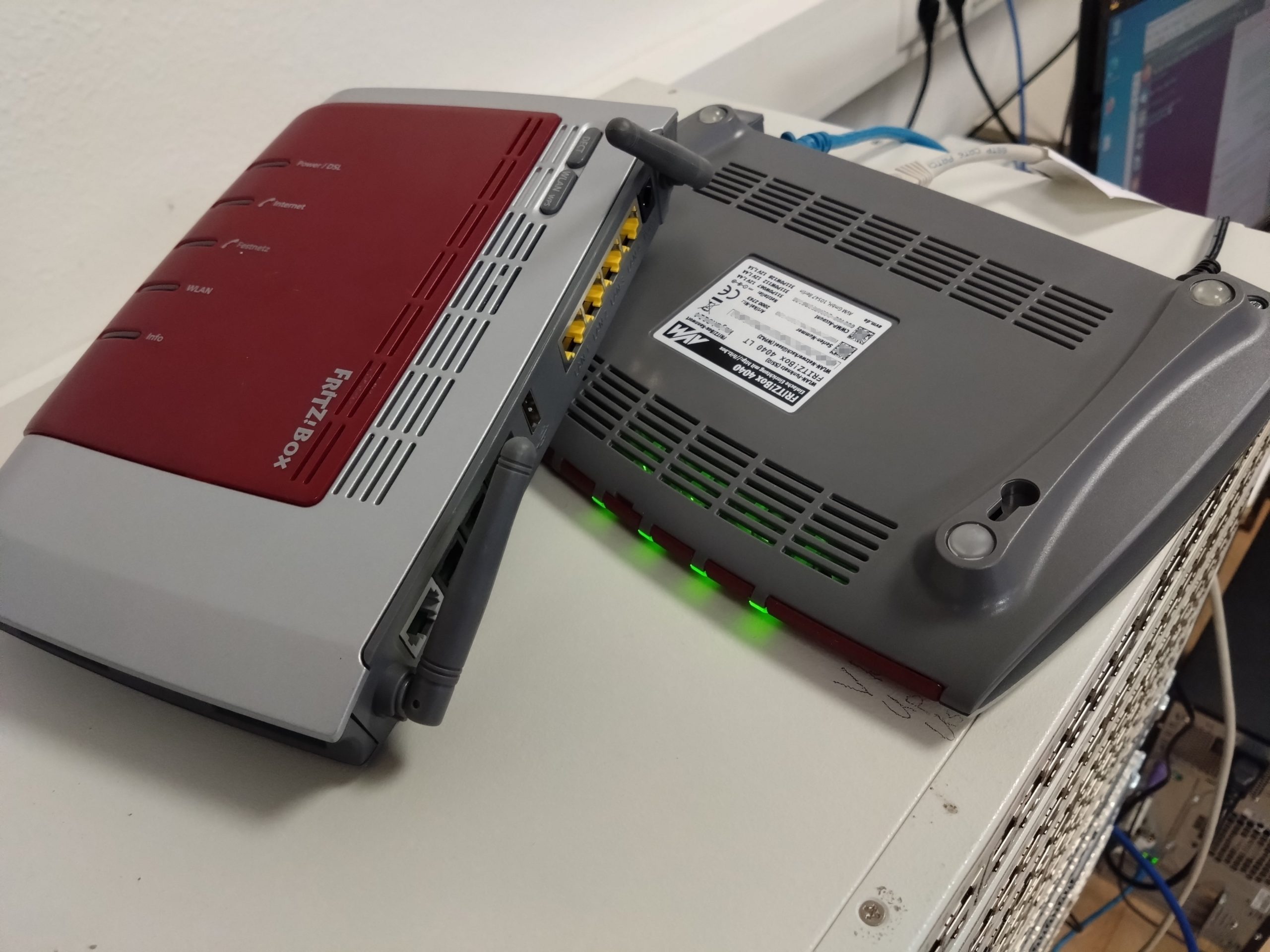
We will no longer support FritzBox routers

Starting from April 1, 2024, we will no longer support FritzBox routers in our network.

For a short while now, we’ve had all the permissions needed to tackle the ongoing issue with FritzBox routers.

We’ve been advising against using FritzBox routers for a while due to their cost and features that are unnecessary for a student dormitory setting. We’ve also linked to this advice in our guide since 2022.

Besides the wasted money, we’ve received complaints from various dorm areas saying, “when I’m away for a while and come back, I have to unplug and replug my router to get online.”

We were able to reproduce this issue widely when we upgraded a slightly neglected dormitory to Gigabit at the beginning of the year. During the upgrade, the dormitory also received Alcatel switches, which we’ve been exclusively using since 2012. With these switches, those with compatible routers could now enjoy Gigabit, but for those using FritzBox, the situation got worse.

Currently, it seems that FritzBox routers are the only ones unable to obtain an IP from our DHCP server a second time, eventually going offline.

We are conducting a small test setup to try and replicate this phenomenon observed in the wild, but it’s taking time.
We should invest in the next generation of switches, but that takes too long considering the short time residents stay in the dormitory, making it unreasonable to ask anyone to daily reset their FritzBox.

Therefore, we’ve decided to phase out FritzBox routers from our network by April 1, 2024, the start of the summer semester.

Those with older devices can receive a special configuration for their connection from us. Old devices are defined as: FritzBox routers that were in use in either of the two dormitories before their upgrade (Konrad-A-Str. and Viktor-R-Str.), i.e., the winter semester of 2023-2024.

In all other dorm areas, FritzBox routers haven’t worked for almost a decade, so we see no legitimate reason for complaints.

Anyone buying a FritzBox, despite our advice since 2022, will have to live with potentially needing to reconnect it daily. We will not invest our volunteer time into a special connection configuration just because someone chose to spend more money on a product we advise against.

When and how we will deploy our next generation of switches, which manufacturer they will be from, and whether FritzBox routers will work with them is not yet decided, and we ask that you refrain from inquiries about this.

Those interested in network technology are, of course, welcome to discuss and research this issue with us, but “I paid a lot of money and want my device to work” is not an argument here!

In short: from the summer semester of 2024, we will no longer support FritzBox routers in our network.
Four out of nearly 6000 connections blocked

In rare cases, we must temporarily block certain connections to protect our network. This is done because of what are called abuse reports, which indicate that abusive activities might be happening from a connection. We receive this report from the BelWü-CSIRT (Computer Security Incident Response Team), and our task is to stop the abuse with appropriate actions, which we do by turning off the connection of the room.

What is an abuse report?

In short, an abuse report is triggered when suspicious or unusual activities are observed coming from an internet connection. This could be, for example, sending spam emails or unauthorized attempts to access other computers. Often, you may not be aware of this behavior because it is usually caused by viruses or other malicious software that has secretly installed itself on one of the devices in the network.

No blame on you

We want to emphasize that such a blocking is in no way meant as a blame towards the affected users. In most cases, you are victims of malicious software acting without your knowledge. Our priority is to quickly identify and solve the problem to prevent further damage.

Why we block the connection

The fastest and most effective way to inform you about a possible security issue is by temporarily turning off the connection. This measure immediately attracts attention and prompts most users to contact us right away. This way, we can address the problem together as quickly as possible.

We are almost always available

Please note that we are also available on weekends and outside regular working hours. If your internet connection unexpectedly stops working, do not hesitate to contact us. We are ready to analyze the problem and offer you steps to solve it. Together, we can ensure that your connection is quickly safe and fully functional again.

Conclusion

The security and reliability of our network are very important to us. Through proactive measures like these, we want not only to ward off potential threats but also to raise awareness of the importance of network security. We thank you for your understanding and cooperation in keeping our shared digital environment safe.

If you have any questions or concerns, we are always here for you.

Outlook for 2024

In August 2024, the Netz-AK will turn 20 years old.

Now, at the end of 2023, we would like to roughly present our plans for the coming year.

After some restructurings between the network of the Studierendenwerk and us, we hope be able to start in the year by providing Wi-Fi to the first buildings. We would like to begin due to the very poor mobile reception in the dormitories on Geissweg in Tübingen. As part of the Wi-Fi expansion, the dormitories will also be simultaneously upgraded to Gigabit in the rooms. Additionally, a new building on Fruwirthstrasse in Hohenheim is expected to be completed, which we are also allowed to equip with Wi-Fi and Gigabit.

Over the course of the year, we would like to upgrade all houses to Gigabit and also increase the nodes to 10 G to avoid bottlenecks.

Currently, as of December 2023, we are only four, but we hope for the return of our fifth member from the Erasmus program and possibly some voluntary support.

There is a lot to do, and you can support us with little technical knowledge, by writing good tutorials or adding some social skills. =)
You are also welcome to learn a lot from us. We do not offer a direct course for which you can earn ECTS points, but you can participate in the expansion and operation of a not-so-small network with just under 6000 rooms. A challenge is that our network is spread over 180 km when laid out in a row.

We document what we do, operate and expand the monitoring of the network to detect failures early and ideally replace defective components before they fail. We help you get your routers and all devices online and operate them securely.

Whether we will finally introduce IPv6 in 2024 or get closer to implementing Eduroam in communal areas and open spaces around the buildings is still open and depends entirely on how much manpower we can muster, but we are confident to make further progress.

Our student members are usually generously supported by the Studierendenwerk with extended “Wohnzeit”.

We are very proud to operate one of the most cost-efficient student networks, where residents have paid significantly less than 3 euros per room and month as part of their rent for fast internet access over the past decades.

Quo vadis Gigabit?

In Geislingen, Sigmaringen, and Albstadt, we have installed Gigabit switches for quite some time. It was more of a coincidence that these places were equipped with Gigabit internet before Tübingen and Hohenheim.

We have just checked how many residents of the dormitories actually use the offered Gigabit internet.

The results are somewhat sobering: In Albstadt, 53% of the residents use the Gigabit internet, in Sigmaringen it’s 33%, and in Geislingen only 25%.

This raises the question of whether we have not informed well enough that Gigabit can be used with the right router, or whether the residents simply do not need such high internet speed.

Hohenheim 16th of May

We were able to accomplish almost everything we had planned yesterday.

We dismantled and disconnected the three generations of network technology that were stacked on top of each other.

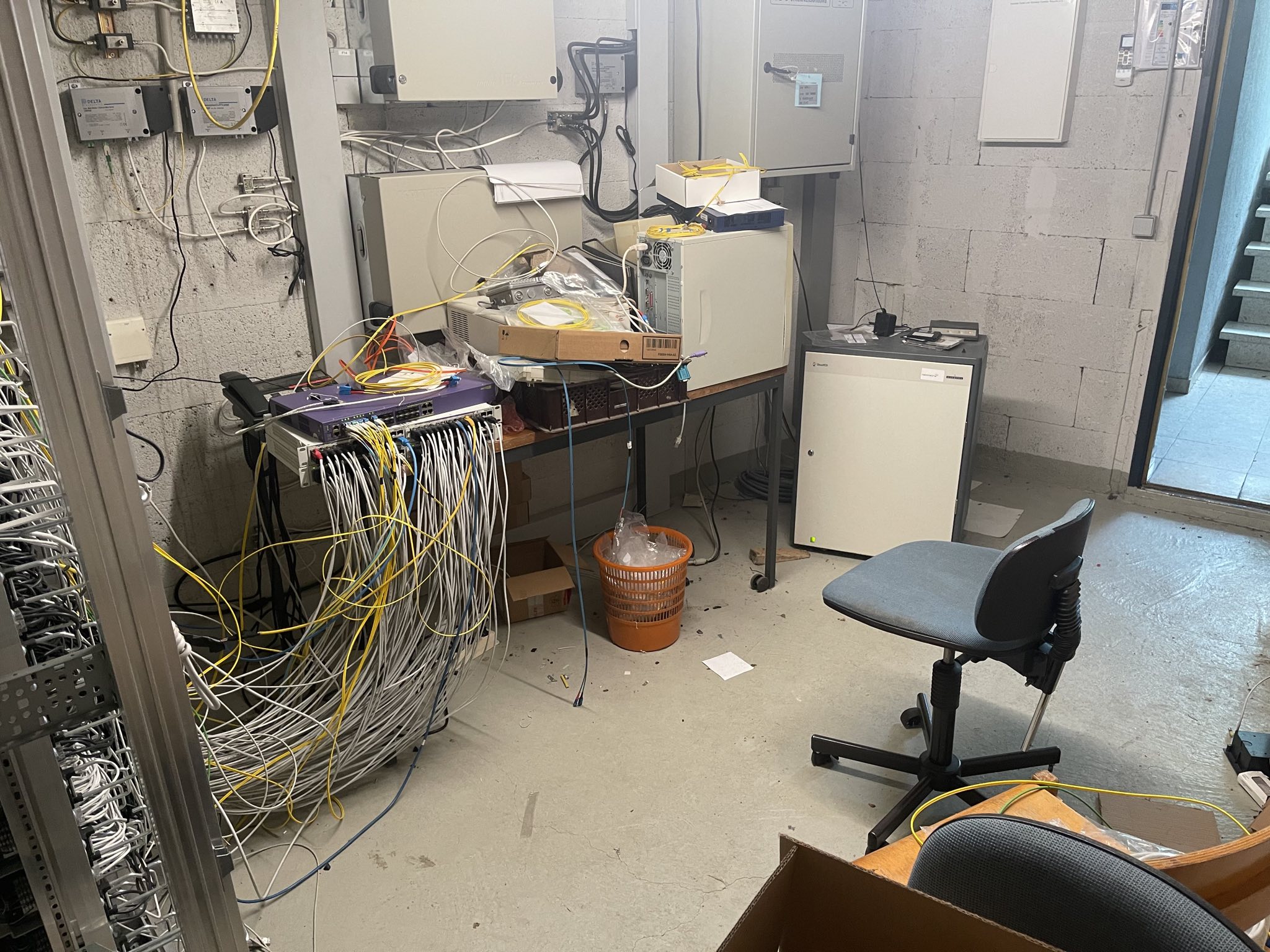
We managed to clean the room to some extent with a broom we found. Once we speak to the janitor, we will find a place for all the electronic waste (see picture).

One of the switches currently in use didn’t look promising during the removal, so we will replace it this Tuesday evening (starting from 6 PM, depending on traffic).

This means that we will need to unplug the cables of the residents of Egilolfstraße 51 to 59 again, and they won’t have internet during this time. Some rooms will be offline for about an hour, while others will experience shorter outages.

Afterward, the room should be prepared for the installation of the main network connection for the entire Hohenheim area.

The relocation and upgrade of this connection still depend on the IT department of the student services.

We hope that with this cleanup operation, we have eliminated any obstacles that could potentially further delay the final resolution of the network issues in Hohenheim.